“From Forests to Future: Sustainable Wealth and Climate Action through Agarwood”
This course empowers participants to grow high-value Agarwood sustainably while contributing to global carbon reduction initiatives. It bridges scientific plantation management, modern agroforestry practices, and carbon farming strategies, turning land into a dual-purpose asset—economic and environmental.
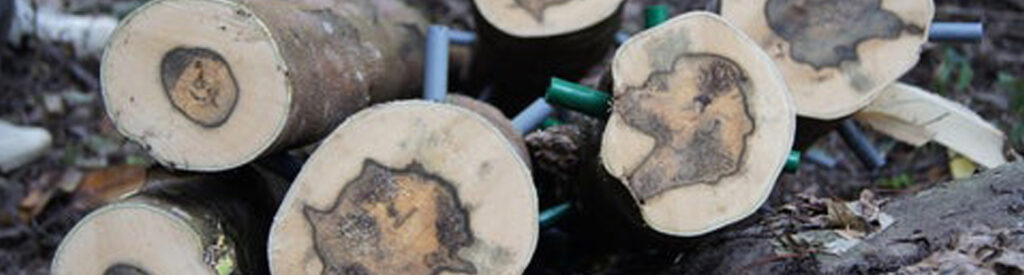
Agarwood (Aquilaria malaccensis), long prized for its fragrance, resin, and cultural significance, has historically been a scarce and highly valuable commodity. Today, the demand for sustainably cultivated Agarwood has never been higher, both for perfumery and wellness industries.
At the same time, the global climate crisis demands innovative carbon sequestration solutions. Forests are one of the most powerful natural tools for mitigating climate change, and Agarwood plantations are uniquely suited to generate carbon credits while producing high-value resin and timber.
“Plant for Profit. Farm for the Planet.”
Every participant will leave with:
- Practical, hands-on knowledge for Agarwood plantation success
- Expertise in carbon farming for global compliance and monetization
- A toolkit for turning forests into sustainable financial and environmental assets
Course Overview / Rationale
- Course Title: Sustainable Agarwood Plantation Management & Carbon Farming Course
- Duration: 2-day intensive workshop + field training
- Target Audience: Farmers, agroforestry practitioners, agripreneurs, investors, environmental NGOs, carbon project developers
- Goal: Equip participants with both technical and business knowledge to manage agarwood plantations sustainably, and to leverage carbon sequestration benefits (e.g., carbon credits) as an additional revenue stream.
- Outcomes:
- Understand agarwood biology, cultivation, and resin formation.
- Implement agroforestry-based plantation design.
- Use sustainable practices (soil, water, biodiversity).
- Understand carbon sequestration and carbon credit mechanisms.
- Develop a viable business plan that integrates resin production + carbon farming.
Course Modules / Syllabus
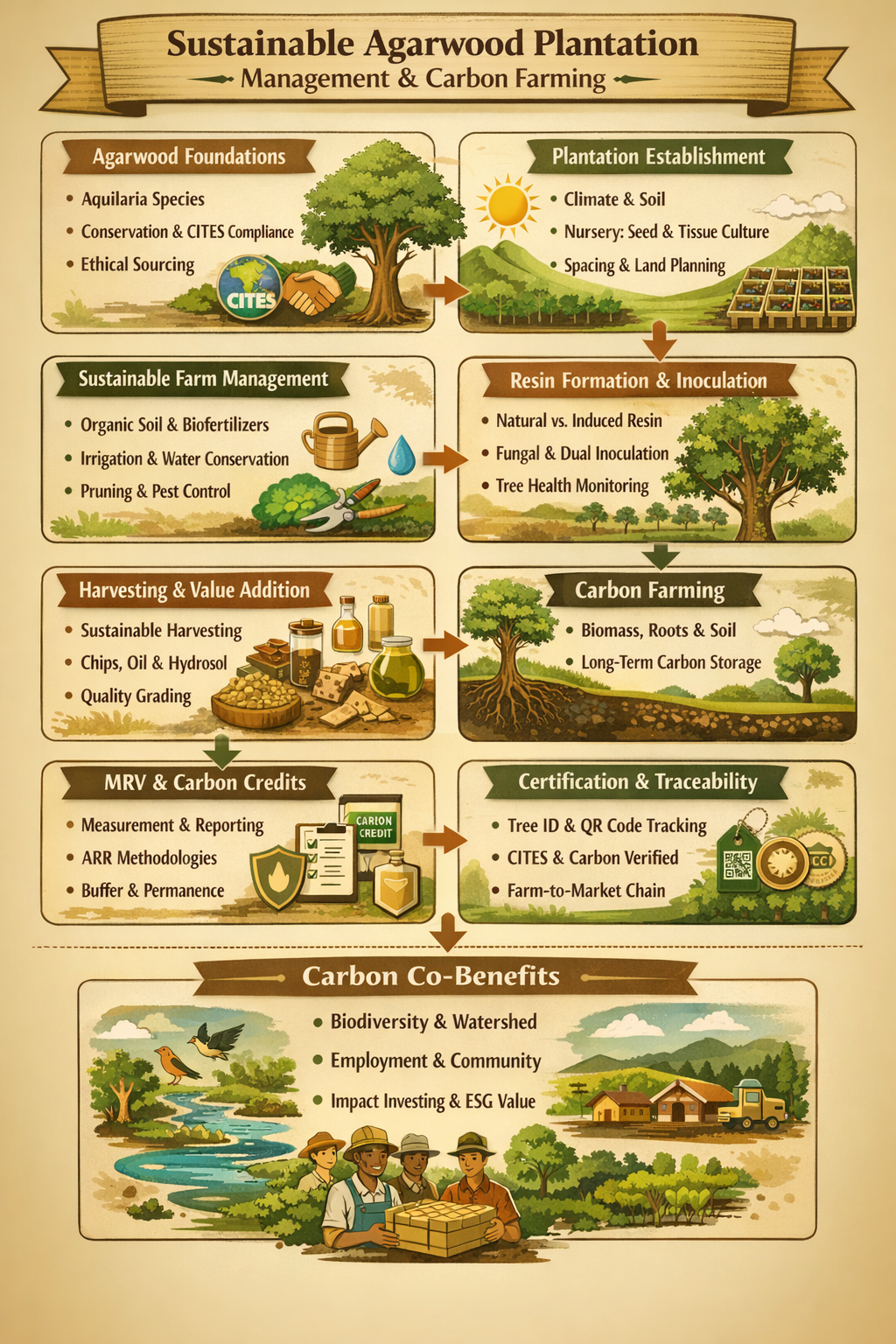
Module 1: Introduction & Context
- Agarwood / Aquilaria species overview (taxonomy, native species, growth)
- Global and local market for agarwood (chips, oil, resin)
- Conservation issues, CITES, and regulatory frameworks
- Carbon farming concept: why agarwood plantations matter for carbon sequestration
- ESG and impact investing opportunities in agarwood
Module 2: Site Selection & Agroforestry Design
- Climate, soil, and topography requirements for agarwood
- Agroforestry models: intercropping, nitrogen-fixing species, shade management
- Nursery management: propagation via seed, tissue culture, hardening
- Land use planning, spacing, density, and layout
Module 3: Soil, Nutrition & Water Management
- Soil fertility, organic amendments, biofertilizers
- Irrigation strategies, water conservation, rainwater harvesting
- Fertilizer management: findings from nutrient studies on agarwood
Module 4: Inoculation & Resin Induction
- Biology of agarwood formation: natural vs. induced resin development
- Artificial inoculation techniques (fungal, chemical, dual-action)
- Best practices for wound injection, tree health, monitoring
Module 5: Plantation Management & Maintenance
- Pruning, canopy management, pest/disease control, organic management
- Harvesting techniques: sustainable harvest, minimizing damage, resin assessment
- Value-added processing: chips, oil (e.g., distillation), hydrosol
Module 6: Carbon Sequestration & Carbon Project Development
- How agarwood sequesters carbon: biomass, soil, roots, deadwood
- Estimating carbon stocks, growth curves, and sequestration rates
- Carbon credit mechanisms: methodologies (e.g., ARR, Verra VM0047)
- MRV (Measurement, Reporting, Verification): sampling plots, inventory, remote sensing
- Risk management, permanence, buffer pools, safeguards
Module 7: Business Planning & Economics
- Cost-benefit analysis of agarwood + carbon farming
- Financing: grants, ESG funds, green investment, carbon buyers
- Legal & regulatory: permits, land tenure, CITES, environmental compliance
- Monitoring and record-keeping for farm management
Module 8: Sustainability, Ethics & Impact
- Conservation and biodiversity: how plantations can support ecosystems
- Carbon co-benefits: watershed protection, employment, community benefits
- Certification and traceability (e.g., ethical sourcing, verification)
Delivery Methods
- Hybrid Format: Combine online lectures/webinars (for theory) + in-person field visits/training (for practicum)
- Workshops: interactive group work, case study discussions, project planning
- Guest Speakers: experts in forestry, carbon markets, inoculation technology, regulatory authorities
- Mentorship: pairing participants with experienced farm managers or carbon project developers
- Resource Materials: slide decks, readings (scientific papers, guidelines), field manuals
Assessment & Certification
- Assessment Methods:
- Module quizzes (online)
- Field assignment: mapping, MRV planning
- Final project / business proposal
- Peer review + instructor feedback
- Certification: Certificate of Completion for participants who pass assessments and submit final project
- Accreditation (optional): Partner with a local university, agricultural department, or certification body to give official recognition
Key Resources & References
- Agarwood nutrient management: AGRIVITA study on fertilizer needs (Agrivita)
- Growing Aquilaria in hill ecosystems (agroforestry) (Forest Pathology)
- Carbon feasibility and MRV / credit methodology (Verra, ARR) (Putz Agarwood Farm)
- Carbon sequestration data for agarwood plantations (Putz Agarwood Farm)
Risks, Challenges & Considerations
- Regulatory Risk: CITES, land tenure, environmental compliance.
- Carbon Credit Risk: Validation costs, registry fees, verification, permanence.
- Market Risk: Volatility in both agarwood resin/oil markets and carbon credit prices.
- Technical Risk: Inoculation failure, low survival, poor yield.
- Sustainability Risk: Overharvesting, biodiversity loss if not well-managed.