Agarwood Cultivation & Sustainable Farming Course
Agarwood has always been more than a tree.
It is a living symbol of resilience — a silent forest sentinel capable of transforming stress into something rare, fragrant, and deeply treasured. For centuries, its secrets were guarded by nature, whispered through ancient trade routes, and understood only by those who walked the forest with reverence.
Today, the future of agarwood is no longer in the wild.
It is in the hands of a new generation of growers, visionaries, and land stewards who believe that prosperity and sustainability can coexist.
The Agarwood Cultivation & Sustainable Farming Course was born from this belief.
At its heart lies a commitment to restore balance — between science and tradition, between economic ambition and environmental responsibility, between what we extract from nature and what we return to it.
This course redefines agarwood farming as a climate-smart, traceable, and community-empowering enterprise, built on the foundations of ecological wisdom and modern biotechnology.
We bridge field experience from upland communities with breakthrough research in organogenesis, inoculation science, and agroforestry design. We teach farmers the value of ethical practices. We prepare entrepreneurs for global markets. And we equip local governments, cooperatives, and plantation managers with the strategies needed to build resilient, compliant, and profitable agarwood enterprises.
Ultimately, this course exists for one purpose: to shape responsible custodians of the next generation of agarwood plantations.
Every seedling planted, every inoculation done with care, every community trained, and every sustainably produced kilogram of resin — becomes part of a larger story:
A story of restoration.
A story of livelihood.
A story of hope for forests and farmers alike.
This is the promise of the Agarwood Cultivation & Sustainable Farming Course:
Not just to teach how agarwood is grown
—but to inspire how its cultivation can uplift ecosystems, empower communities, and build a sustainable, globally respected Philippine agarwood industry.
Course Description
The Agarwood Cultivation & Sustainable Farming Course is a comprehensive training program designed to equip farmers, researchers, agripreneurs, and industry stakeholders with the scientific, practical, and ethical foundations of agarwood production. The course integrates botany, agroforestry, biotechnology, induction systems, sustainability principles, and market readiness, ensuring globally competitive and environmentally responsible agarwood cultivation.
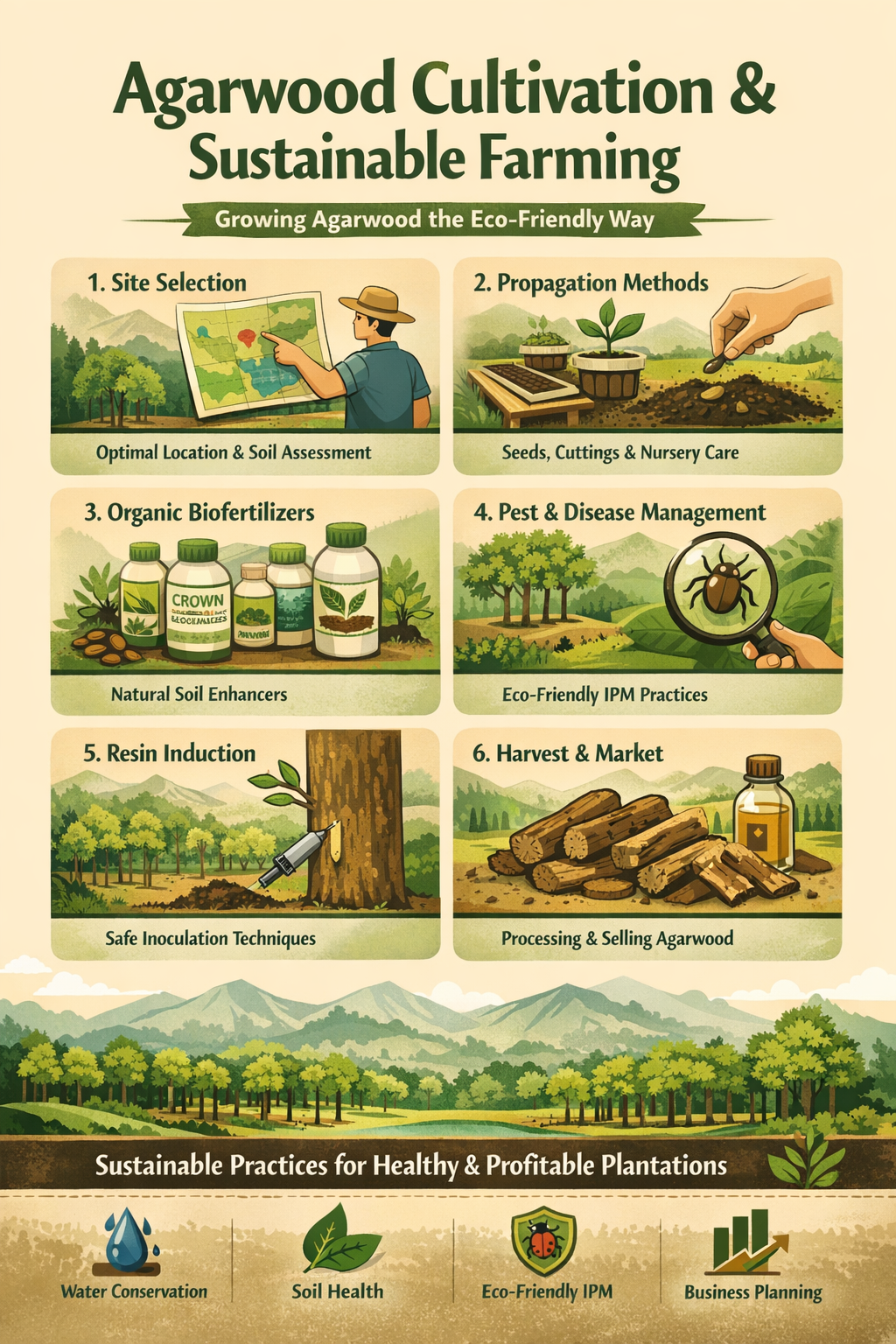
This course provides an in-depth understanding of Aquilaria spp. (agarwood) cultivation from nursery to plantation, emphasizing sustainable farming systems, soil health, and the application of organic biofertilizers developed by Crown Organic Biofertilizers, Inc. (COBI). Students will learn modern techniques in site selection, propagation, plant nutrition, pest and disease management, inoculation strategies for resin induction, and farm business systems.
Course Objectives
By the end of the course, participants will be able to:
- Understand the biology and ecology of Aquilaria species
- Design and manage sustainable agarwood plantations
- Apply modern agarwood induction techniques responsibly
- Monitor tree health, resin formation, and farm productivity
- Align cultivation practices with ethical, regulatory, and market standards
Learning Outcomes
By the end of this course, participants will be able to:
- Identify appropriate sites and design agarwood plantations that optimize growth and sustainability.
- Execute propagation techniques (seed, cutting, tissue culture).
- Understand soil science fundamentals and apply organic soil health improvement practices.
- Apply COBI biofertilizers effectively in the field to enhance plant nutrition and health.
- Implement integrated pest and disease management using sustainable approaches.
- Perform efficient and safe agarwood inoculation for resin induction.
- Develop business models and farm plans for profitable agarwood enterprise.
Full Course Syllabus
Module 1 — Introduction to Agarwood – Foundations of the Industry & Ecology
Learning Objectives:
- Understand the biology, ecology, and species diversity of Aquilaria.
- Recognize global and ASEAN agarwood market dynamics.
- Appreciate sustainability, conservation, and legal frameworks.
Topics:
- What is Agarwood? Formation, resin biology, and cultural history.
- Aquilaria species overview (native Philippine species, introduced spp.).
- Ecological significance & role in forest ecosystems.
- Value chain overview: chips, oil, incense, perfumery, wellness.
- Global & local market: demand, supply, pricing patterns.
- CITES, DENR regulations, permits, licensing, and ethical trade.
Module 2 — Site Selection & Farm Planning – Designing a Sustainable Agarwood Plantation
Learning Objectives:
- Select ideal climate, soil, and terrain for Aquilaria.
- Design agroforestry-based layouts for productivity and biodiversity.
Topics:
- Climate parameters (rainfall, elevation, wind, microclimates).
- Soil analysis: pH, texture, drainage, organic matter & amendments.
- Land assessment: slope, shade, accessibility, water sources.
- Plantation layout: density, spacing, cluster vs linear planting.
- Agroforestry integration: nitrogen-fixing species, shade trees, intercrops.
- Irrigation systems: low-cost to advanced drip options.
Module 3 — Propagation & Nursery Management – Ensuring High-Quality Planting Material
Learning Objectives:
- Learn propagation via seeds, cuttings, and tissue culture.
- Manage a nursery for strong, disease-free seedlings.
Topics:
- Seed selection, viability testing, sterilization.
- Tissue culture (micropropagation & organogenesis) overview.
- Nursery setup: shade nets, humidity, watering, root development.
- Hardening & acclimatization protocols.
- Nursery pest/disease management.
Module 4 — Plantation Establishment & Maintenance – Tree Health, Growth, and Productivity
Learning Objectives:
- Implement field planting, maintenance, and canopy management.
- Apply organic/sustainable inputs for rapid, healthy growth.
Topics:
- Planting techniques: timing, hole preparation, mulching.
- Fertility management: compost teas, mycorrhizae, organic fertilizers.
- Weed control: manual, mulching, cover crops.
- Pruning systems and canopy management for resin formation.
- Pests and diseases in the plantation and their control.
- Monitoring schedules (monthly, quarterly, annual).
Module 5: Soil Health, Fertility & Organic Biofertilizers
Topics:
- Soil chemistry, physical & biological properties
- Principles of sustainable soil management
- Introduction to Crown Organic Biofertilizers, Inc. products
- Types (e.g., microbial inoculants, compost, rock minerals)
- Mode of action and benefits
- Matching biofertilizer products to soil needs
Activity: Soil test interpretation; product matching exercise
Module 6: Application of Organic Biofertilizers
Topics:
- Application timing and methods (nursery & field)
- Seedbed amendment
- Transplant root dip
- Soil drench, foliar spray
- Dosing rates and safety measures
- Why and how organic biofertilizers improve soil biology
Field: Biofertilizer application demo on nursery beds
Module 7: Water & Nutrient Management Systems
Topics:
- Water requirements for Agarwood
- Irrigation planning for sustainability
- Nutrient cycling and soil–plant nutrient dynamics
- Integrating organic inputs with irrigation
Workshop: Creating nutrient schedules
Module 8: Integrated Pest & Disease Management (IPDM)
Topics:
- Common pests and pathogens in agarwood plantations
- Low-impact control strategies
- Role of organic amendments in disease suppression
- Monitoring and record-keeping
Field: IPDM walk in plantation
Module 9: Resin Induction for Agarwood Production
Topics:
- Biology of resin formation
- Types of inoculation systems
- Timing and field protocols
- Safety, hygiene, and quality controls
Lab/Field: Inoculation technique demonstration
Module 10: Harvest Management & Post-Harvest Considerations
Topics:
- Indicators for harvest readiness
- Harvest techniques that preserve wood quality
- Storage and handling
- Traceability and compliance
Module 11: Data Management & Farm Records
Topics:
- Essential farm record systems
- Using digital tools for tracking growth, inputs, yields
- Simple budgeting and cost analysis
Workshop: Creating farm record templates
Module 12: Business Planning & Value-Added Systems
Topics:
- Business models for agarwood enterprises
- Product diversification (chips, oil, luxury wood)
- Market access strategies and partnerships
- Financing, cooperatives, and investment attraction
Guest Lecture: Agarwood market expert
Field Practicum
40 hrs (flexible schedule)
- Implementation of a starter plot
- Practical application of COBI biofertilizers
- Ongoing monitoring and reporting
Suggested Materials & Tools
- Soil testing kits
- Propagation supplies (seed trays, media)
- Irrigation setup
- Digital farm records (Excel or mobile app)
- Safety gear for fieldwork